- - ABC-INDEX - -

11/27/2013

kami hair amulets

[ . BACK to DARUMA MUSEUM TOP . ]
:::::::::::::::::::::::::::::::::::::::::::::::::::::::::::::::::::::::::::::::::::::::::::::::::::::::::::::::::::::::::::::::::::::::::::::::::::::::::::::::::::::::::::

kami 髪 amulets for hair
bihatsu kigan 美髪祈願 praying for beautiful hair

kami no ke kigan no jisha 髪の毛祈願の寺社

There are some shrines and temples especially to pray for beautiful hair.

髪のパワースポット - power spot for your hair

..............................................................................................................................................

. kushi 櫛 comb and kanzashi かんざし / 簪 hairpin .

. bijin 美人 beauty - beauty amulet 美守 .

..............................................................................................................................................


One of the disciples of Shakyamuni Buddha was a hairdresser.


source : ctworld.org.tw/sutra_stories

Ubari 優波離 Upali

- quote
Upali (Sanskrit उपालि upāli) was a monk, one of the ten chief disciples of the Buddha. Before joining the order, he worked as a barber. He asked the Buddha if a person of "low birth" such as he could join the order.
The Buddha ordained him before the princes and asked the princes to pay homage to Upali, who by then had become an Arhant.
He became the chief disciple in knowing the rules of the order and the foremost disciple in keeping precepts.
© More in the WIKIPEDIA !


:::::::::::::::::::::::::::::::::::::::::::::::::::::::::::::::::::::::::::::::::::::::::::::::::::::::::::::::::::::::::::::::::::::::::::::::::::::::::::::::::::::::::::


Hatsuju Shin ji 髪授神祠 Small Shrine to Pray for Hair -
香川県高松市宮脇町1-30-3 - Takamatsu, Kagawa

In the compound of Iwaseo Hachiman Guu Hachiana Jinja 石清尾八幡宮境内蜂穴神社


source : Hirataku flickr

deities in residence

Akiguhi no Ushi no Kami 飽昨能宇斯神
(born from the crown corona of Izanagi)
Unemenosuke Fujiwara no Masayuki 采女亮藤原政之

The words KAMI 神 for deity and KAMI 髪 for hair have a close relationship.
Here the main festival takes place in November.
People with babies also come to pray for healthy hair growth and offer a cut of first hair.
Young people with thin hair or older people with white hair also come to pray.


CLICK for more photos.

There is a memorial stone called 毛魂碑


..............................................................................................................................................


Mikami Jinja 御髪神社
京都府京都市右京区嵯峨小倉山田渕山町10-2 Kyoto


source : www.mikami-jinja.net

This shrine is rather new, it has been built in 1961 by members of the hairstyle and beauty salons, wig makers and hair studios to pray for good business 理美容業界. It is a very small shrine and only sells amulets for hair problems.

The deity in residence is Unemenosuke Fujiwara no Masayuki 采女亮藤原政之
the first hairdresser.
Revered as Mikami Daimyoojin 御髪大明神 Great Deity of Hair.

- quote
This shrine enshrines Fujiwara Unemenosuke Masayuki.
In the 13th century, his father, Fujiwara Motoharu served the emperor Kameyama. At that time, he lost treasures in his territory. He began a quest and travelled to the western part of Japan. He finally settled down in Shimonoseki in Yamaguchi prefecture, and his son, Masayuki became a hairdresser as a regular vocation. That was the origin of the god of this shrine. There is a tumulus of hair here, since hair is regarded as the very important thing for human being because it is on the very top of human which is offered by the world spirit.
It protects our important brain, and we have to appreciate the great gift from the god.
- source : www.small-japan.net


There is also a kamizuka 髪塚 hair mound, tumulus of hair in the compound. People pray during the great spring festival
「われら生けるもの 御髪大明神の大いなる御魂をうけ ひたすら御名を称えまつる」

During a shrine visit, you have to ask the priest to cut a bit of your own hair. It is put in a special little sack and you can offer it to the deity, then your own hair will grow back beautifully and bountifully.
御髪献納

On the ema votive tablets is written
薄毛が治りますように - may my thin hair be healed soon!
and it is often frequented by men.


櫛型のお守り amulet in form of a comb


櫛型の絵馬 ema votive tablet in form of a comb


HP of the shrine
- www.mikami-jinja.net

source : omamorida.com/spot

..............................................................................................................................................


Seki Jinja 関神社
in the compound of Ooji jinja 王子神社, Kyoto
東京都北区王子本町1-1(王子神社境内)

This shrine is dedicated to priest Semimaru 蝉丸法師 and Sakagami Hime 逆髪姫

- quote
Semimaru also known as Semimaro
was a Japanese poet and musician of the early Heian period.
. . . In the Noh Theater there is a play called "Sekimaru" that depicts the life of a woman named Sakagami (逆髪), who came to Ausaka no Seki and initially quarrelled with Semimaru, but eventually they fell in love and later had a painful separation.
© More in the WIKIPEDIA !


source : youkaiblog.blog75

Princess Sakagami was suffering from "hair standing up" (sakagami) and Semimaru tried to help her. He ordered Beautiful Furuya 古屋美女 to make a wig (かもじ, かつら) to help her.
He himself thus became the first deity for hair problems.
Many owners of hair salons come here to pray for good business. Lately also women come to pray for help with their hair problems.


kezuka 毛塚 stupa to pray for beautiful hair


kami no soshin 髪の祖神 first deity for hair problems


. Seki Semimaru jinja 関 蝉丸神社 shrine for Semimaru .
at Ausaka Barrier (Osaka Barrier) 逢坂の関


- reference : tencoo.fc2web.com/jinja/xseki

..............................................................................................................................................


Yanagi no i 柳の井 well of the willow
柳井堂 Hall of the Willow Well
東京都文京区湯島3-32-4 Tokyo


It the compound of the temple Shinjooin 心城院 Shinjo-In in Edo was the famous
yanagi no ido 柳の井戸 well of the willow tree

If the ladies washed their hair with this sacred water, their hair would become soft and shining - at least in the legends of the Edo period.

The deity of this temple is Daishoo Kangiten 大聖歓喜天.
It belongs to the Tendai sect of Buddhism.

. 湯島聖天 Yushima Shoten 柳井堂 Yanagii-Do 心城院 Shinjo-In .


. Kankiten (Kangiten 歓喜天 Ganesh .


set for the New Year shrine visit
bihatsu kigan 美髪祈願 praying for beautiful hair
- source : news.livedoor.com/article


:::::::::::::::::::::::::::::::::::::::::::::::::::::::::::::::::::::::::::::::::::::::::::::::::::::::::::::::::::::::::::::::::::::::::::::::::::::::::::::::::::::::::::


source : geocities.jp/tyuou59/hiikawa.

- quote
Kushinadahime クシナダヒメ - Kushi inada hime -名田比売 - 奇稲田姫
The daughter of Ashinazuchi and Tenazuchi. About to be devoured by the serpent Yamata no orochi, Kushinada hime was saved by Susanoo in exchange for becoming his wife. Susanoo transformed the girl into a comb and placed her in his hair, then defeated the serpent. He afterwards built a palace in Izumo where he married her. Kojiki states that Susanoo composed a song on the occasion of his wedding:

Clouds arise one on another:
The manyfold fence of Izumo;
Build that manyfold fence,
the manyfold fence
To enfold the new bride


This song was later valorized as a sacred verse representing the roots of Japanese waka poetry. Susanoo and Kushinadahime produced the child Yashimashinumi, said to be ancestor of Ōkuninushi. The Izumo fudoki includes a report associating Kushinada with the origin of the local place name for Kumadani ("secluded valley"), stating that "Kushiinada Mitoyomanurahime" chose the place when seeking a quiet site to give birth.
- source : Mori Mizue、Kokugakuin


. Izumo Fudoki 出雲 風土記 Legends from Izumo .


:::::::::::::::::::::::::::::::::::::::::::::::::::::::::::::::::::::::::::::::::::::::::::::::::::::::::::::::::::::::::::::::::::::::::::::::::::::::::::::::::::::::::::


- reference - advice-navi.com/beauty/hair

- reference - at2.tactnet.co.jp

:::::::::::::::::::::::::::::::::::::::::::::::::::::::::::::::::::::::::::::::::::::::::::::::::::::::::::::::::::::::::::::::::::::::::::::::::::::::::::::::::::::::::::

ochanai おちゃない female collectors of fallen hair
ochikai 落ち買い "buying fallen things"


There was also a profession of ladies in Edo to walk around and collect the hair that had fallen out and been combed off a woman's head.
The hair was then used to make wigs. Hair in the Edo period was also called
kamoji かもじ (か文字 ー  髪文字), a dealer in fallen hair was
kamojiya 髪文字屋 / 髢屋

On their walk through town thay called out loudly

otchanai ochanai おちゃないおちゃない Are there hair fallen?
this is short for
ochite inai ka 落ちていないか "Has (any hair) fallen to the ground?"

They carried the hair in a furoshiki bundle on their head. They usually started their business in the late afternoon (giving women time after the lunch preparations to collect their hair).

- reference -

. Katsura 鬘 wigs and hairstyles in Edo .

. Doing Business in Edo - 江戸の商売 .

:::::::::::::::::::::::::::::::::::::::::::::::::::::::::::::::::::::::::::::::::::::::::::::::::::::::::::::::::::::::::::::::::::::::::::::::::::::::::::::::::::::::::::


. Join the MINGEI group on facebook ! .  


. bijin 美人 beauty - beauty amulet 美守 .

. biyoo jisha 美容寺社 praying for beauty .


. Regional Folk Toys from Japan .

. Japan - Shrines and Temples .


. Tohoku after the BIG earthquake March 11, 2011

[ . BACK to WORLDKIGO . TOP . ]
[ . BACK to DARUMA MUSEUM TOP . ]

:::::::::::::::::::::::::::::::::::::::::::::::::::::::::::::::::::::::::::::::::::::::::::::::::::::::::::::::::::::::::::::::::::::::::::::::::::::::::::::::::::::::::::

11/25/2013

bijin beauty

[ . BACK to DARUMA MUSEUM TOP . ]
:::::::::::::::::::::::::::::::::::::::::::::::::::::::::::::::::::::::::::::::::::::::::::::::::::::::::::::::::::::::::::::::::::::::::::::::::::::::::::::::::::::::::::

bijin 美人 beauty - beauty amulet 美守 - bijin kigan 美人祈願お守り

Next to prayers for good health, prayers for a beautiful face, skin or body were quite popular.

Ono no Komachi 小野 小町 was a famous poetess and beauty of the Heian period.
Ladies come to her temple to pray for beauty . . .

. Ono no Komachi 小野 小町 - Komachidera 小町寺 .
temple Fudara-Ji 補陀洛寺 in Kyoto


. biyoo jisha 美容寺社 praying for beauty .


. kami 髪 amulets for beautiful hair .
櫛型のお守り amulet in form of a comb
櫛型の絵馬 ema votive tablet in form of a comb

. Edo no bijin 江戸の美人 the beauties of Edo .

:::::::::::::::::::::::::::::::::::::::::::::::::::::::::::::::::::::::::::::::::::::::::::::::::::::::::::::::::::::::::::::::::::::::::::::::::::::::::::::::::::::::::::

quote
source : omamorida.com/spot/05kinki
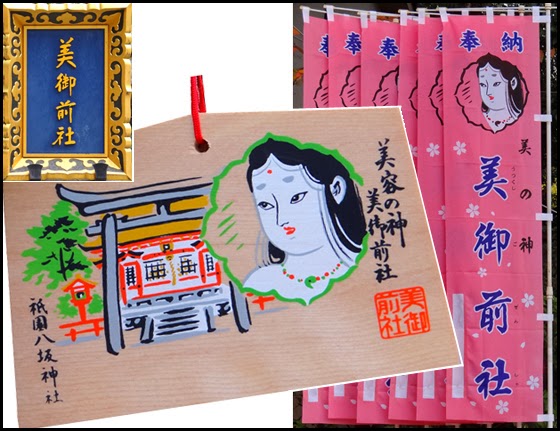
from Yasaka Jinja 八坂神社 in Kyoto


bi mamori 美守(美人祈願)to become beautiful


美御前社絵馬(美人祈願)to become beautiful

..............................................................................................................................................


In the compound is also the shrine Utsukushi Gozen Sha 美御前社
with three beautiful female deities:

Ichikishima Hime no Mikoto 杵島比売命 - 中津島姫命 Nakatsushima hime no mikoto
Tagiri Hime no Mikoto  多岐理比売命
Tagitsu Hime no Mikoto   多岐津比売命

To say prayers in front of them will bring beauty, beautiful skin and a beautiful heart to the person - like a spiritual "beauty liquid" 美容水 from the nearby well.


. LINK BIG font .

..............................................................................................................................................


source : kyoto-k.sakura.ne.jp


- quote
Utsukushiki-gozen Shrine and Beauty Water
Visiting the Shrine of Beauty, the Guardian Deity of Beauty in Kyoto


Standing on the east side of the main hall of Yasaka Shrine, the Utsukushi-gozen Shrine, is dedicated to three female deities of beauty: Ichikishima-hime-no-kami, Tagiri-hime-no-kami, and Tagitsu-hime-no-kami. It is said that if you visit this shrine you will be blessed with beauty in both mind and body and it is well known that many young women, including the geisha and maiko, female Japanese dancers of Gion, come to visit the shrine.
In addition, it is said that if you wash your hands and face with the "beauty water" from the spring on the grounds, your skin and heart will be beautified.
- source : micro.rohm.com/en/rohm-saijiki


..............................................................................................................................................


. Yasaka Jinja 八坂神社 Yasaka Shrine, Kyoto .

3 daughters of Amaterasu
Sannyoshin 宗像三女神 (also written 胸形三女神), the "Three Female Kami of Munakata."
. Ichikishimahime 市杵島姫 - 中津島姫命 Nakatsushima hime no mikoto .
Sayoribime no mikoto
Takishi hime, Takiri Hime タキツヒメ・タキリヒメ
at Munakata Taisha 宗像大社


:::::::::::::::::::::::::::::::::::::::::::::::::::::::::::::::::::::::::::::::::::::::::::::::::::::::::::::::::::::::::::::::::::::::::::::::::::::::::::::::::::::::::::


kagami ema 鏡絵馬 votive tablet as a mirror

You can paint the part of your face that should improve its beauty.


source : guide.travel.co.jp

at Kawai Jinja 河合神社, Kyoto - Shimogamo Shrine complex

They also sell
karin sui かりん水 beauty water to improve the facial beauty.


karin is Chinese quince.


source : miiiiio.exblog.jp

日本第一美麗神 The Most Beautiful Deity of Japan

- quote
. . . Its main selling point is that the kami specialises in women’s beauty, and the ema votive tablets are accordingly shaped like a mirror. Female visitors are invited to draw their face on the front and write down a request to become more beautiful. The ema are then displayed in front of the shrine.
Kawai Jinja also celebrates its connection with Kamo no Chomei (1153-1216) . . .
- source : www.greenshinto.com


:::::::::::::::::::::::::::::::::::::::::::::::::::::::::::::::::::::::::::::::::::::::::::::::::::::::::::::::::::::::::::::::::::::::::::::::::::::::::::::::::::::::::::


source : blog.onekoreanews.net

「姿美人は一時の花 心美人は一生の宝 心美人になれますように」


at shrine Tsuyu no Ten Jinja 露天神社 - Osaka Sonezaki 曽根崎
famous for the bunraku story of the love suicide of Sonezaki


. Sonezaki Shinju 曽根崎心中 The Love Suicides at Sonezaki .
Chikamatsu Monzaemon 近松門左衛門


:::::::::::::::::::::::::::::::::::::::::::::::::::::::::::::::::::::::::::::::::::::::::::::::::::::::::::::::::::::::::::::::::::::::::::::::::::::::::::::::::::::::::::


source : www.omairibiyori.com

Look carefully for the White Rabbit of Inaba on the bottom.

from . Kanda Myoojin Shrine 神田明神 Kanda Myojin Shrine . - Tokyo


. The White Rabbit of Inaba 因幡の白兎.


:::::::::::::::::::::::::::::::::::::::::::::::::::::::::::::::::::::::::::::::::::::::::::::::::::::::::::::::::::::::::::::::::::::::::::::::::::::::::::::::::::::::::::

. Sennyuji, Mitera 御寺 泉涌寺 Mitera Sennyu-Ji, Kyoto .
Mitera 御寺 The Honorable Temple (of the Imperial Family)


Yookihi Kannon, Yōkihi Kannon 楊貴妃観音 Yokihi Kannon

amulet to become as beautiful as Princess Yokihi

Yokihi Kannon is made of precious aromatic wood. The statue created by the order of Emperor Xuan Zong of the Tang dynasty of China, after the death of his beloved princess Yokihi.
The precious wood for this statue seems to have been shipped from Japan to China, where the statue was made. Kannon then came back to Japan, with the wish to protect the ships on their dangerous trip to and from China.


. Yookihi 楊貴妃 Yokihi - Princess Yang Gui Fei .
a famous Chinese beauty


source : hotsuma816nifuku

. Kannon Bosatsu 観音菩薩 .


:::::::::::::::::::::::::::::::::::::::::::::::::::::::::::::::::::::::::::::::::::::::::::::::::::::::::::::::::::::::::::::::::::::::::::::::::::::::::::::::::::::::::::

- - - - - biyoo no kami 美容の神様 deities of beauty

Munakata Sanjin 宗像三神 - Sannyoshin - Three Sisters (see above)

. Semimaru-gami 蝉丸神 .
at Semimaru Jinja 蝉丸神社, Shiga Otsu

. Toyotama Hime 豊玉姫 .

..............................................................................................................................................


- - Three hot springs for beauty 日本三大美人の湯
Kawanaka Onsen 川中温泉
Ryuujin Onsen 龍神温泉 "Dragon King" hot spring
Yunokawa, Yu no Kawa Onsen 湯の川温泉

- - Three hot springs for beautiful skin 日本三大美肌の湯
Ureshino Onsen 嬉野温泉
Hinokami Onsen 斐乃上温泉
Kitsuregawa Onsen 喜連川温泉
- source : www.advice-navi.com/beauty/spa


:::::::::::::::::::::::::::::::::::::::::::::::::::::::::::::::::::::::::::::::::::::::::::::::::::::::::::::::::::::::::::::::::::::::::::::::::::::::::::::::::::::::::::


. Join the MINGEI group on facebook ! .  


. Regional Folk Toys from Japan .

. Japan - Shrines and Temples .


. Tohoku after the BIG earthquake March 11, 2011

[ . BACK to WORLDKIGO . TOP . ]
[ . BACK to DARUMA MUSEUM TOP . ]

:::::::::::::::::::::::::::::::::::::::::::::::::::::::::::::::::::::::::::::::::::::::::::::::::::::::::::::::::::::::::::::::::::::::::::::::::::::::::::::::::::::::::::

11/19/2013

hahako

[ . BACK to DARUMA MUSEUM TOP . ]
:::::::::::::::::::::::::::::::::::::::::::::::::::::::::::::::::::::::::::::::::::::::::::::::::::::::::::::::::::::::::::::::::::::::::::::::::::::::::::::::::::::::::::

hahako 母子 / 母と子 mother and child dolls

. Anzan Kosodate 安産子育て all about amulets for Children .

Boshijin, Hahakogami 母子神 "Mother-Child Deity"

- quote -
Boshijin "Mother-child kami,"
a term used to refer to the joint enshrinement of a mother deity (boshin) and its child deity (mikogami).
Also read hahakogami.
The practice of such joint enshrinement is itself found widely from Eurasia through Southeast Asia and Oceania, and is thought to be linked to primitive "mother-goddess" beliefs.
Boshijin practices in Japan can be found at the shrine Kamo Jinja and within Hachiman beliefs. According to fragmentary records of the Yamashiro no kuni fudoki, Tamayorihime and Kamo Taketsunumi no mikoto, two deities worshiped at the Kamo Mioya Jinja (the Lower Kamo Shrine), are related as daughter and father, and in turn they are in relation of mother and maternal grandfather to Kamo Wakeikazuchi no kami, the deity worshiped at the Kamo Wakeikazuchi Jinja (Upper Kamo Shrine). In the fragmentary Yamashiro no kuni fudoki, Tamayorihime was impregnated supernaturally via a "red arrow" which floated downstream on the river, and thus gave birth to Kamo Wakeikazuchi no kami; the arrow, in turn, was said to be an transformation of the kami Honoikazuchi no kami enshrined in Otokuni District of Yamashiro Province. The worship at these two shrines is clear evidence of belief in mother-child deities.

Shrines dedicated to Hachiman likewise enshrine both the deities Homudawake (Emperor Ōjin) and his mother Okinagatarashihime (Empress Jingū), but some scholars believe that the legend of Empress Jingū should not be taken as a historical association. Rather, it may be one version of a tradition of mother-child kami within the context of worship of sea deities, specifically a version whereby a sea-faring goddess arrives from across the sea and gives birth to a child deity at the shore.

Further, one version of the work Hachimangudōkun recounts a legendary origin for the shrine Ōsumi Shō-Hachimangū, according to which a princess of Cinasthâna (an ancient Indian name for China) was miraculously impregnated at the age of seven by a ray of sunlight. When she then gave birth to a child, the king was suspicious, and set her adrift in an empty boat. The place where she came ashore was the Japanese province of Ōsumi (present-day Kagoshima Prefecture). This legend thus hints of the wide dissemination of beliefs in mother-child deities. It may also be that such belief in mother-child deities lies behind legends of "tiny children" seen, for example, in tales like Momotarō, Issunbōshi, and Urikohime. In such legends, the kami appears in the form of a "divine child," but such children almost always have a close relation to the realm of water, indicating a background of mother-goddess cult.
- source : Kobori Keiko Kokugakuin -


. Awashima sama 粟島さま at Awashima Jinja 淡島神社 - Wakayama .
with prayers for children


. sanbi 産火 / 産忌 fire taboos for childbirth .

:::::::::::::::::::::::::::::::::::::::::::::::::::::::::::::::::::::::::::::::::::::::::::::::::::::::::::::::::::::::::::::::::::::::::::::::::::::::::::::::::::::::::::


CLICK for more photos !
made by 岩崎信江

kokeshi no oyako こけしの親子 wooden Kokeshi dolls

:::::::::::::::::::::::::::::::::::::::::::::::::::::::::::::::::::::::::::::::::::::::::::::::::::::::::::::::::::::::::::::::::::::::::::::::::::::::::::::::::::::::::::


source : t_kousaka_jp/7121322.

博多母子人形 Hakata Dolls

. Dolls from Hakata / 博多人形 .

:::::::::::::::::::::::::::::::::::::::::::::::::::::::::::::::::::::::::::::::::::::::::::::::::::::::::::::::::::::::::::::::::::::::::::::::::::::::::::::::::::::::::::


source : rakuten.co.jp/yuuyuu

eto zodiac animal by Ikoma Naomi 生駒奈於実 - for the year 2014


. 12 Zociac animals 干支  eto, kanshi .


:::::::::::::::::::::::::::::::::::::::::::::::::::::::::::::::::::::::::::::::::::::::::::::::::::::::::::::::::::::::::::::::::::::::::::::::::::::::::::::::::::::::::::

Aichi - 愛知県
. Okoshi 起土人形 and 尾北人形 Bihoku .

Akita - 秋田県
- - - . Kosaka tsuchi ningyoo 小坂土人形 clay dolls from Kosaka .
- - - . Nakayama tsuchi ningyoo 中山土人形 .

Chiba - 千葉県
. Shimofusa hariko 下総張子 papermachee dolls from Shimofusa .

Fukushima - 福島県
. Miharu hariko 三春張子 papermachee dolls from Miharu .

Hiroshima - 広島県
. Tookaichi tsuchi ningyoo 十日市土人形 clay dolls from Tokaichi .

Iwate - 岩手県
. Hanamaki tsuchi ningyoo 花巻土人形 Hanamaki clay dolls .

Kagoshima - 鹿児島
. 鹿児島 土人形 Kagoshima Clay Dolls .

Nagano - 長野県
. Narai tsuchi ningyo 奈良井土人形 clay dolls from Narai .

Niigata - 新潟県
. Clay dolls from Sado and Suibara 佐渡土人形 水原土人形.

Shizuoka - 静岡県
. Kanaya tsuchi ningyo 金谷土人形 clay dolls from Kanaya .

Toyama - 富山県
. Watanabe Nobuhide 渡辺信秀 clay doll maker .

Yamagata
- 山形県、
. clay dolls from Sakata and Sagara 酒田土人形 相良土人形 .

..............................................................................................................................................


Kyoto 京都


source : blog.nihondorei.com

Mother carrying a baby on her back 子背負い人形

. Fushimi Ningyo 伏見土人形 Clay dolls from Fushimi .


..............................................................................................................................................

Kumamoto 熊本県


This doll is about 25 cm high.

There is also
yamanba 山姥(やまんば) old mountain wife, who breastfeeds a baby.
This is said to be a symbol of Mother Mary feeding the baby Christ.

. Amakusa tsuchi ningyoo 天草土人形 Amakusa Clay Dolls .

..............................................................................................................................................

- reference : blog.nihondorei.com

:::::::::::::::::::::::::::::::::::::::::::::::::::::::::::::::::::::::::::::::::::::::::::::::::::::::::::::::::::::::::::::::::::::::::::::::::::::::::::::::::::::::::::

母子人形
. . . CLICK here for Photos !

. Reference .

:::::::::::::::::::::::::::::::::::::::::::::::::::::::::::::::::::::::::::::::::::::::::::::::::::::::::::::::::::::::::::::::::::::::::::::::::::::::::::::::::::::::::::

. Legends and Tales from Japan 伝説 - Introduction .

母子 / 母子岩 and many animal legends
- reference : nichibun yokai database -
24 to explore

:::::::::::::::::::::::::::::::::::::::::::::::::::::::::::::::::::::::::::::::::::::::::::::::::::::::::::::::::::::::::::::::::::::::::::::::::::::::::::::::::::::::::::


. Join the MINGEI group on facebook ! .  


. Regional Folk Toys from Japan .


. Tohoku after the BIG earthquake March 11, 2011

[ . BACK to WORLDKIGO . TOP . ]
[ . BACK to DARUMA MUSEUM TOP . ]
- #boshijin #hahako #motherchild -
:::::::::::::::::::::::::::::::::::::::::::::::::::::::::::::::::::::::::::::::::::::::::::::::::::::::::::::::::::::::::::::::::::::::::::::::::::::::::::::::::::::::::::

11/17/2013

minwa legends

[ . BACK to DARUMA MUSEUM TOP . ]
. Japanese legends and tales 伝説 民話 昔話 - Introduction .
:::::::::::::::::::::::::::::::::::::::::::::::::::::::::::::::::::::::::::::::::::::::::::::::::::::::::::::::::::::::::::::::::::::::::::::::::::::::::::::::::::::::::::

minwa 民話 folktales / densetsu 伝説 legends

. minzokugaku 民俗学 / 民族学 folklore studies, ethnology .


. Manga Nihon Mukashibanashi まんが日本昔ばなし
Old Stories from Japan - Folktales- Legends - ABC list .


. kataribe 語り部 story teller, storyteller, Geschichtenerzähler .


. Legends about animals 動物と伝説 - ABC-List .

:::::::::::::::::::::::::::::::::::::::::::::::::::::::::::::::::::::::::::::::::::::::::::::::::::::::::::::::::::::::::::::::::::::::::::::::::::::::::::::::::::::::::::


Tales of Old Japan (1871)
. Algernon Bertram Freeman-Mitford アルジャーノン・フリーマン=ミットフォード .


:::::::::::::::::::::::::::::::::::::::::::::::::::::::::::::::::::::::::::::::::::::::::::::::::::::::::::::::::::::::::::::::::::::::::::::::::::::::::::::::::::::::::::

- - - - - . Fukushima - 福島  . - - - - -

. Minwa Jinja 民話神社 Minwa Shrine of Folk Tales . - at Koriyama Station 郡山駅
and more stories to explore


:::::::::::::::::::::::::::::::::::::::::::::::::::::::::::::::::::::::::::::::::::::::::::::::::::::::::::::::::::::::::::::::::::::::::::::::::::::::::::::::::::::::::::

- - - - - . Iwate Folk Art - 岩手県  . - - - - -

Toono monogatari, Tōno monogatari 遠野物語 Tono Monogatari
Legends of Tono


- Mizuki Shigeru - Tono Monogatari 水木しげるの遠野物語


- quote
The term Yama-bito (山人), as understood in Japanese folklore, has come to be applied to a group, some scholars claim, of ancient, marginalized people, dating back to some unknown date during the Jomon period of Japanese history.

Tono Monogatari
According to Yanagita, the Yamabito were "descendants of a real, separate aboriginal race of people who were long ago forced into the mountains by the Japanese who then populated the plains" during the Jomon era.

Yanagita wrote down these folktales in the book Tono Monogatari, though as author Sadler notes:
"The book is a classic of folklore, but it has none of the usual trappings of a volume of folktales. There is no attempt to classify. There are no headings and no categories. The book is a ramble, and a hodge-podge. You will find fairy tales and legends and even an occasional myth in it; but you will also find the stuff of the tabloid newspapers: Distraught youth murders mother with sharpened scythe or, Hayseed knifes mom."

kamikakushi 神隠し
One of the concepts Yanagita presents in Tono Monogatari is that of, literally, being spirited away, or kamikakushi. As author Sadler relates:
"A young girl is at play under the pear tree in her yard one evening toward dusk, and in the next instant she is gone, vanished. Thirty years later the occupants of her old family home are surprised by a visitor whom they recognize at once as this child, now grown to womanhood. She looks haggard and old. She is silent, except for the half-apologetic remark that she 'just wanted to see everyone once more,' and then she departs as silently and mysteriously as she came. Evidently no one attempts to follow her, and no one asks her to stay. Her story remains untold. No one wants to hear it. They know what it is. She is kamikakushi ... literally, she has been hidden by the kami, by the spirits. She has been enslaved by some supernatural being. "
© More in the WIKIPEDIA !


Tr. Ronald A. Morse


. O-Shirasama, oshirasama おしらさま / O-Shirase sama お知らせ様 .
Okunaisama オクナイサマ - 家の神 Deity in the Home in Tono, Iwate
"Neighing horse deity", menari myojin 馬鳴明神
"Silkworm God", kaikogami, sanjin 蚕神 , カイコガミ
"White Deity", O-Shirasama, oshirasama おしらさま、オシラサマ
"White Buddha", O-Shira butsu オシラ仏, おしら仏
Okonai sama オコナイサマ / Okunai sama オクナイサマ
Kokage Myoojin 蚕影明神 / Kodama sama 蚕玉様. 蚕養神
Memyoo Kannon, Memyoo Benten, Memyoo Yakushi
馬鳴菩薩・観音・弁天・薬師 / Komagata Myojin 駒形明神
Tobigami 飛神 "flying god"


. Story Nr. 99 死者の想い Thinking of the Dead .
and the connection of the Great Tsunami of 1896 and 2011.


. Sen to Chihiro no Kamikakushi 千と千尋の神隠し Spirited Away .
animated fantasy-adventure film


. futtachi 脛立 /フッタチ / 経立 Futtachi, "old animal Yokai monster" .
They appear in the 遠野物語 Tono Monogatari legends of Iwate.

:::::::::::::::::::::::::::::::::::::::::::::::::::::::::::::::::::::::::::::::::::::::::::::::::::::::::::::::::::::::::::::::::::::::::::::::::::::::::::::::::::::::::::


Tales from a Mountain Cave Stories from Japan’s Northeast
By Hisashi Inoue / Translated by Angus Turvill

- quote
. . . Futuristic cities, or the romance of samurai and geisha — for many foreigners, these are the twin poles around which Japanese culture revolves. But there is another, deep history that feels as though it’s been present in Japan for millennia despite only being documented in the past century. In 1912, bureaucrat Kunio Yanagita published a book that spawned an entire scholarly discipline, minzokugaku (folklore studies): “Tono Monogatari (The Legends of Tono).” It’s no coincidence that the Japanese title of Inoue’s “Tales from a Mountain Cave” is “Shinshaku Tono Monogatari” — shinsaku meaning “a new version” or, perhaps, “revisited.”

The original legends of Tono are not, it is certain, tales to read to children. There is the infamous “Tale 69,” of a girl who loved her horse so deeply that “they became husband and wife” — until her appalled father hangs the animal from a mulberry tree. “Tale 55″ laconically records how women in a certain village are often made pregnant by kappa, water spirits — and that the resulting infants are so grotesque they are chopped in pieces and buried in wine casks.

Yanagita’s source was an educated young man from a peasant family who told the scholar his stories in 1909. “Tales from a Mountain Cave” likewise opens with author Inoue introducing his source, but we’ve jumped over two world wars in the interim. The year is 1953 — though at first glance you’d hardly know it. Here again is a sorrowful tale of a girl who loves her horse too much; a lost traveler who discovers a baby in the cooking pot at the house where he seeks shelter; a pond with a curious guardian; and more kappa, leaving the women alone this time, but still up to no good.

They ought to seem laughable, these relics of a Japan that existed before Hiroshima and Nagasaki, before the postwar ningen-sengen (Humanity Declaration) of the Emperor Showa, here being dragged into the 1950s. And yet Inoue’s stories are woven tightly to the fabric of contemporary history. The tale of the carter’s daughter, Aoe, and her horse Shiro is set in wartime, its outrageous conclusion precipitated by the arrival in their village of soldiers requisitioning horses for army transport. A yarn of gruesome revenge that makes creative use of a wooden box comes from the eve of war, when a group of mineworkers go on the run. Inoue himself is a university dropout, forced to work in a sanatorium to make ends meet in the tough postwar years, while the tale-teller, is a former professional musician uprooted from Tokyo. (Or is he?)

All the tales play out against a backdrop of rural hardship.
No tsunami breaks during “Tales from a Mountain Cave” (although the original “Legends of Tono” contains the story of Fukiji who lost his wife in a such a wave and lives with his children in a shelter on the site of their destroyed home). Instead, famine bites so hard that fathers sell their daughters, a young man has to live as an unpaid labourer in the fields of his rich relatives, taxes are unendurable, children drown, and men accused of crime are forced into bonded labor. Yet amid all the poverty and struggle is a magical world of trickster creatures, where true love is real (if sometimes ill-advised) and fortunes may mysteriously be made (if always at a price).
In “Tales from a Mountain Cave” the residents of the Ofunato-Kamaishi-Kesennuma region don’t just survive — their lives are touched with wonder, and anything can happen.
- source : japantimes.co.jp

:::::::::::::::::::::::::::::::::::::::::::::::::::::::::::::::::::::::::::::::::::::::::::::::::::::::::::::::::::::::::::::::::::::::::::::::::::::::::::::::::::::::::::

Shizuoka 静岡県

More than 100 folktales, from (磐田市、袋井市、森町)
第43話 (かっぱのさら) カッパの皿 (豊岡村) Kappa no sara
- source : www.chuen.net/mukashi

:::::::::::::::::::::::::::::::::::::::::::::::::::::::::::::::::::::::::::::::::::::::::::::::::::::::::::::::::::::::::::::::::::::::::::::::::::::::::::::::::::::::::::


. Join the MINGEI group on facebook ! .  

:::::::::::::::::::::::::::::::::::::::::::::::::::::::::::::::::::::::::::::::::::::::::::::::::::::::::::::::::::::::::::::::::::::::::::::::::::::::::::::::::::::::::::

. Japanese legends and tales 伝説 民話 昔話 - Introduction .

. Regional Folk Toys from Japan .

. Japan - Shrines and Temples .


. Tohoku after the BIG earthquake March 11, 2011

[ . BACK to WORLDKIGO . TOP . ]
[ . BACK to DARUMA MUSEUM TOP . ]
- - - - - #legends #minwa - - - - -
:::::::::::::::::::::::::::::::::::::::::::::::::::::::::::::::::::::::::::::::::::::::::::::::::::::::::::::::::::::::::::::::::::::::::::::::::::::::::::::::::::::::::::

minzoku ningyo dolls

[ . BACK to DARUMA MUSEUM TOP . ]
:::::::::::::::::::::::::::::::::::::::::::::::::::::::::::::::::::::::::::::::::::::::::::::::::::::::::::::::::::::::::::::::::::::::::::::::::::::::::::::::::::::::::::

minzoku ningyoo 民俗人形 folklore dolls


. minzokugaku 民俗学 /民族学 folklore studies, ethnology .


folklore dolls from the whole world


:::::::::::::::::::::::::::::::::::::::::::::::::::::::::::::::::::::::::::::::::::::::::::::::::::::::::::::::::::::::::::::::::::::::::::::::::::::::::::::::::::::::::::


- - - - - Many dolls are representing regional festivals:


. Ainu ningyoo アイヌ人形 from Hokkaido .

. awa odori take ningyoo 阿波踊り竹人形 bamboo dolls from the Awa dance, Tokushima .

. boosan kanzashi 坊さんかんざし / 坊さん簪 "priest with umbrella" from Kochi .

. haneto ningyoo はねと人形 Haneto "jumping" dancer doll from Aomori .

. izumeko ningyoo いずめこ人形 / いづめ子 baby in a basket from Yamagata .

. kagura ningyoo 神楽人形 Kagura dance dolls from Okayama .

. kantoo matsuri 竿灯祭り lantern festival dolls from Akita .

. Karatsu hikiyama 唐津曳山 festival float dolls from Karatsu, Saga .

. ryuu odori 龍踊り dragon dance doll from Nagasaki .

. sansa odori さんさ踊り Sansa dancer dolls from Iwate .

. shanshan odori しゃんしゃん踊り dance girl dolls from Tottori .

. taihei odori 泰平踊り "Peace Dance" dolls from Miyazaki .

. unpin shishimai 雲浜獅子舞 Unpin lion dance dolls from Fukui .

. Yasugibushi 安来節 Yasugi Bushi song dolls from Shimane .

. yome-iri koma 嫁入り駒 horse with bride doll from Kiso, Nagano .


- reference : upp.so-net.ne.jp/u1cku/gangu5
:::::::::::::::::::::::::::::::::::::::::::::::::::::::::::::::::::::::::::::::::::::::::::::::::::::::::::::::::::::::::::::::::::::::::::::::::::::::::::::::::::::::::::


. Join the MINGEI group on facebook ! .  


. Regional Folk Toys from Japan .

. Japan - Shrines and Temples .


. Tohoku after the BIG earthquake March 11, 2011

[ . BACK to WORLDKIGO . TOP . ]
[ . BACK to DARUMA MUSEUM TOP . ]

:::::::::::::::::::::::::::::::::::::::::::::::::::::::::::::::::::::::::::::::::::::::::::::::::::::::::::::::::::::::::::::::::::::::::::::::::::::::::::::::::::::::::::

minzokugaku

[ . BACK to DARUMA MUSEUM TOP . ]
:::::::::::::::::::::::::::::::::::::::::::::::::::::::::::::::::::::::::::::::::::::::::::::::::::::::::::::::::::::::::::::::::::::::::::::::::::::::::::::::::::::::::::


minzokugaku 民俗学  / 民族学 folklore studies, ethnology, cultural anthropology

under construction
:::::::::::::::::::::::::::::::::::::::::::::::::::::::::::::::::::::::::::::::::::::::::::::::::::::::::::::::::::::::::::::::::::::::::::::::::::::::::::::::::::::::::::


. Yanagita Kunio 柳田國男 (1875 - 1692).
father of Japanese native folkloristics, minzokugaku 民俗学.
(Yanagida Kunio)


YANAGITA KUNIO AND JAPANESE FOLKLORE STUDIES IN THE 21ST CENTURY
Edited by Ronald A. Morse, 2012.
This scholarly book about the prominent Japanese folklorist Yanagita Kunio (1875-1962) is downloadable.
It is especially focused on Yanagita's mature theories and writings during the 1930s and 1940s. The book also has up-to-date bibliographical material: "A Guide to Major Foreign Language Writings on Yanagita Kunio and Yanagita Studies" and "A Guide to Japanese Folklore Centers & Resources".
- source : guides.library.harvard.edu

..............................................................................................................................................


The National Museum of Ethnology
(国立民族学博物館, Kokuritsu Minzoku-gaku Hakubutsukan)
is one of the major museums in Japan. It is Japan's largest research institute in the academic disciplines of humanities and social sciences, which was established in 1974 and opened to the public in 1977. It is built on the former grounds of Expo '70 in Suita, Osaka. The founding collection is known as the Attic Collection, and is an early 20th-century ethnological collection of mainly Japanese materials, including some early finds of Jōmon archaeological artifacts (in the Morse Collection). Further collections were brought together for the opening in 1977 and collecting activities have continued since.

The main focus of collection has been film, still images, sound recordings, and objects representing diverse aspects of everyday life, from farming to food, urban life, folk crafts, and religion. Permanent galleries for all large regions of the world display only part of the full collection.

Two special exhibitions of approximately three months duration are presented in Spring and Autumn each year, and there are numerous smaller temporary exhibitions on special themes.
© More in the WIKIPEDIA !


Minpaku 民博 - Ethnology Museum in Osaka - HP in English
- source : www.minpaku.ac.jp


under construction
:::::::::::::::::::::::::::::::::::::::::::::::::::::::::::::::::::::::::::::::::::::::::::::::::::::::::::::::::::::::::::::::::::::::::::::::::::::::::::::::::::::::::::


from the whole world

. minzoku ningyoo 民俗人形 folklore dolls from Japan .


. minwa 民話 folktales / densetsu 伝説 legends .


:::::::::::::::::::::::::::::::::::::::::::::::::::::::::::::::::::::::::::::::::::::::::::::::::::::::::::::::::::::::::::::::::::::::::::::::::::::::::::::::::::::::::::


Daruma no Minzokugaku  ダルマの民俗学 Daruma-Folklore
陰陽五行から解く
Yoshino Hiroko  吉野裕子


. Miso Minzokugaku 味噌民俗学研究 Folklore and Miso paste making .


:::::::::::::::::::::::::::::::::::::::::::::::::::::::::::::::::::::::::::::::::::::::::::::::::::::::::::::::::::::::::::::::::::::::::::::::::::::::::::::::::::::::::::


. Join the MINGEI group on facebook ! .


. Regional Folk Toys from Japan .

. Japan - Shrines and Temples .


. Tohoku after the BIG earthquake March 11, 2011

[ . BACK to WORLDKIGO . TOP . ]
[ . BACK to DARUMA MUSEUM TOP . ]

:::::::::::::::::::::::::::::::::::::::::::::::::::::::::::::::::::::::::::::::::::::::::::::::::::::::::::::::::::::::::::::::::::::::::::::::::::::::::::::::::::::::::::

11/12/2013

Fuji Musume Doll

[ . BACK to DARUMA MUSEUM TOP . ]
:::::::::::::::::::::::::::::::::::::::::::::::::::::::::::::::::::::::::::::::::::::::::::::::::::::::::::::::::::::::::::::::::::::::::::::::::::::::::::::::::::::::::::

Fuji Musume 藤娘人形 Fuji Musume Dolls

Wisteria Maiden, Fuji Musume 藤娘
a famous Kabuki dance


Click on the photo to see more versions !

Fuji Musume (“Wisteria Maiden”) is a famous classical dance out of the Kabuki theater in Japan. Fuji (wisteria) Musume (maiden) was first performed in 1826 at Nakamura-za, Edo and was originally performed as one in a series of five dances.

Later in 1938, Onoe Baiko VII, the most famous Kabuki actor during his time, became associated with the dance after his portrayal of Fuji Musume at the Kabukiza Theater in Tokyo. His choreography and refinement of this dance helped to make it stand out and remain today as one of the most popular and famous Kabuki dances.

The story begins in Otsu, an area in outside of Kyoto and around Lake Biwa. Otsu is a city famous for its paintings. People would stroll its art-lined streets, viewing the beauty of the artisans works.

One painting in particular, that of the wisteria maiden, caught the eye of a male passerby. As he gazed upon the painting, the Wisteria Maiden became infatuated. So infatuated in fact, that she came to life, stepping out of the painting. The maiden is dressed in long flowing kimono; black-lacquered bamboo hat and carrying a beautiful branch of fuji (wisteria). She writes beautiful, heartfelt letters to her love. The letters however go unanswered.

The story continues on as she dances under a beautiful pine tree, covered in wisteria. The dancer expresses the emotions found in unrequited love in the manner of women of the Edo era (1603-1868). Eventually, sadness and despair take over our maiden and, heartbroken, she returns to the painting. Her return to the painting remains the last pose of the dance.

The Fuji Musume dance is accompanied by Nagauta music. Nagauta is the most important school of music in Kabuki theater as it has developed in conjunction with Kabuki.
MORE photos :
© 2007 by Melanie Shintaku. .


The wisteria entangles a pine tree - an old symbol in waka poetry for the Fujiwara clan 藤原 and its trusting relationship with the imperial court (the evergreen pine).


. fuji 藤 (ふじ ) wisteria .

:::::::::::::::::::::::::::::::::::::::::::::::::::::::::::::::::::::::::::::::::::::::::::::::::::::::::::::::::::::::::::::::::::::::::::::::::::::::::::::::::::::::::::


. Hakata Ningyoo 博多人形 Hakata Dolls .


:::::::::::::::::::::::::::::::::::::::::::::::::::::::::::::::::::::::::::::::::::::::::::::::::::::::::::::::::::::::::::::::::::::::::::::::::::::::::::::::::::::::::::


. Hagoita 羽子板 Battledore, Shuttlecock .


:::::::::::::::::::::::::::::::::::::::::::::::::::::::::::::::::::::::::::::::::::::::::::::::::::::::::::::::::::::::::::::::::::::::::::::::::::::::::::::::::::::::::::


藤娘 土鈴 clay bell

:::::::::::::::::::::::::::::::::::::::::::::::::::::::::::::::::::::::::::::::::::::::::::::::::::::::::::::::::::::::::::::::::::::::::::::::::::::::::::::::::::::::::::


:::::::::::::::::::::::::::::::::::::::::::::::::::::::::::::::::::::::::::::::::::::::::::::::::::::::::::::::::::::::::::::::::::::::::::::::::::::::::::::::::::::::::::


Fuji Musume and Daruma on a purse

source : www.a-un.ne.jp/daily

:::::::::::::::::::::::::::::::::::::::::::::::::::::::::::::::::::::::::::::::::::::::::::::::::::::::::::::::::::::::::::::::::::::::::::::::::::::::::::::::::::::::::::


stamp from 1992, with Fuji Musume 藤娘の藤の精

source : www.yushu.co.jp

:::::::::::::::::::::::::::::::::::::::::::::::::::::::::::::::::::::::::::::::::::::::::::::::::::::::::::::::::::::::::::::::::::::::::::::::::::::::::::::::::::::::::::


. . . CLICK here for Photos !

. Reference .

:::::::::::::::::::::::::::::::::::::::::::::::::::::::::::::::::::::::::::::::::::::::::::::::::::::::::::::::::::::::::::::::::::::::::::::::::::::::::::::::::::::::::::


source : calamel.jp/go

野点茶碗 大津絵 藤娘 tea cup with an Otsu-E motive


. Otsu Paintings 大津絵 .


:::::::::::::::::::::::::::::::::::::::::::::::::::::::::::::::::::::::::::::::::::::::::::::::::::::::::::::::::::::::::::::::::::::::::::::::::::::::::::::::::::::::::::


. Regional Folk Toys from Japan .

. Japan - Shrines and Temples .


. Tohoku after the BIG earthquake March 11, 2011

[ . BACK to WORLDKIGO . TOP . ]
[ . BACK to DARUMA MUSEUM TOP . ]

:::::::::::::::::::::::::::::::::::::::::::::::::::::::::::::::::::::::::::::::::::::::::::::::::::::::::::::::::::::::::::::::::::::::::::::::::::::::::::::::::::::::::::